
In March 1981, Etna produced one of the most alarming warning signs for people living on its northern flank: thousands of small earthquakes, increasing in both frequency and intensity, showed that magma was rising and fracturing the side of the volcano.
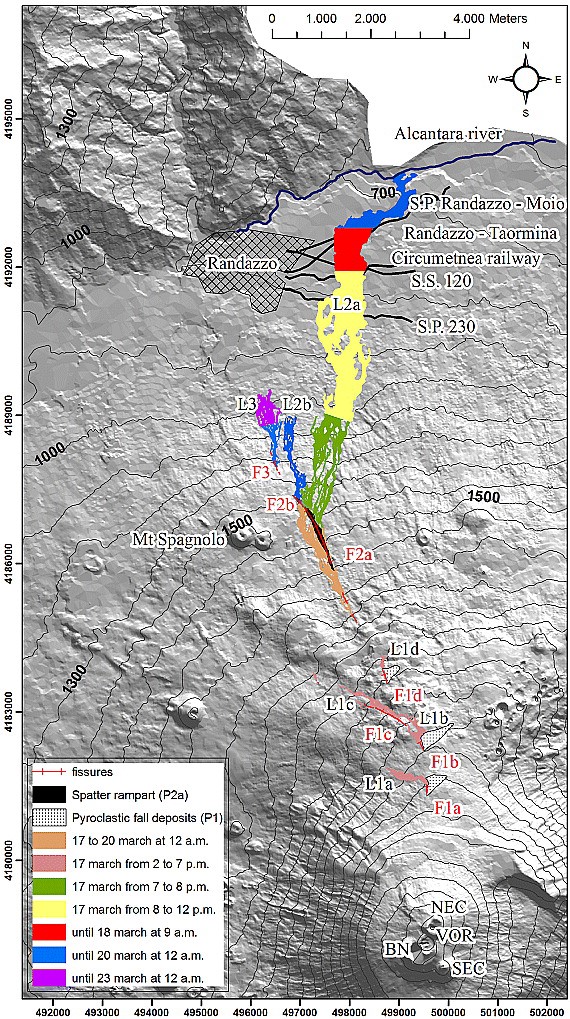
On 17 March, a system of eruptive fissures opened at high altitude. Within a few hours, the fractures propagated downslope and fed an exceptionally fast-moving lava flow heading between Randazzo and Montelaguardia. In two days, the lava crossed woodland and farmland, cut roads and railways, and came close to the inhabited areas.
The warning signs before the eruption
For weeks, Etna’s northern flank had been affected by an earthquake swarm. By 16 March, earthquakes were occurring at a rate of about fifty events per hour, and some were felt in towns on the lower slopes, including Randazzo.
Several kilometres below the surface, a body of magma was forcing its way upwards. The pressure progressively fractured the surrounding rock, generating the earthquakes and suggesting to volcanologists that a flank eruption might be imminent in the northern sector of the volcano.
The previous flank eruption had taken place only a year and a half earlier, in August 1979. For the local population, therefore, these signals were far from abstract.
17 March 1981: Etna’s northern flank opens
At 1:37 p.m. on 17 March, the first eruptive fissures began to open at elevations between 2,625 and 2,500 metres. Volcanologists from the University of Catania and the former International Institute of Volcanology followed the beginning of the eruption, including from a helicopter above the volcano.
The vents produced lava fountains, several small lava flows and occasional phreatomagmatic explosions caused by the interaction between incandescent magma and the thick snow cover. Meanwhile, the fissure system continued to propagate north-northwest, towards Randazzo.
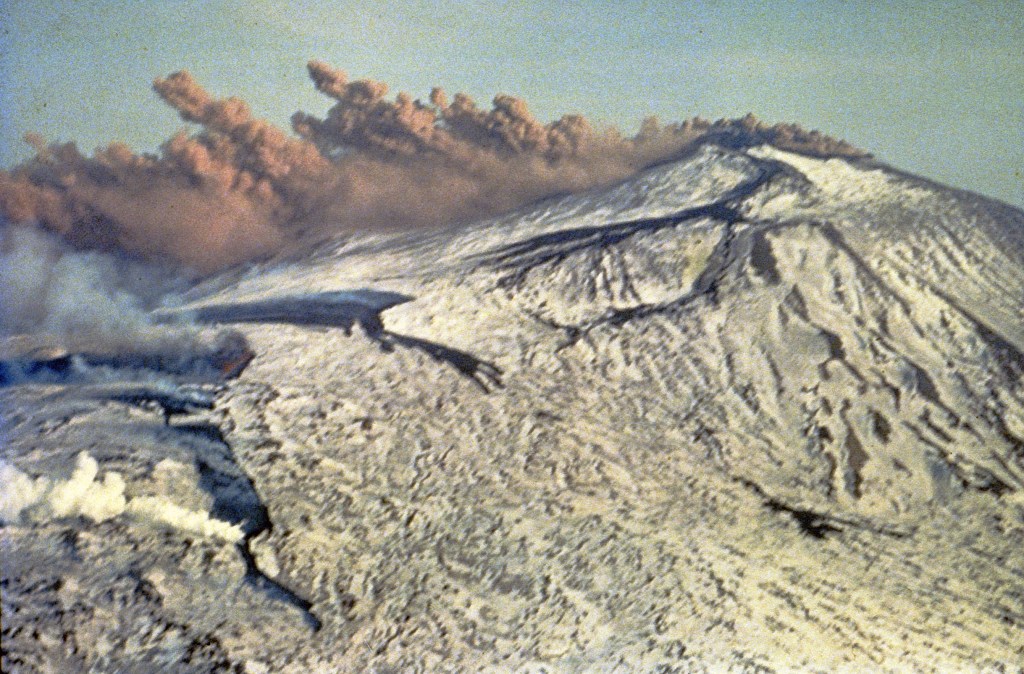
The lava flow accelerates towards Randazzo
On the evening of 17 March, a new fissure opened at an elevation of about 1,800 metres. A much larger lava flow began to emerge from this vent, advancing rapidly northwards and threatening Montelaguardia, a few kilometres east of Randazzo.
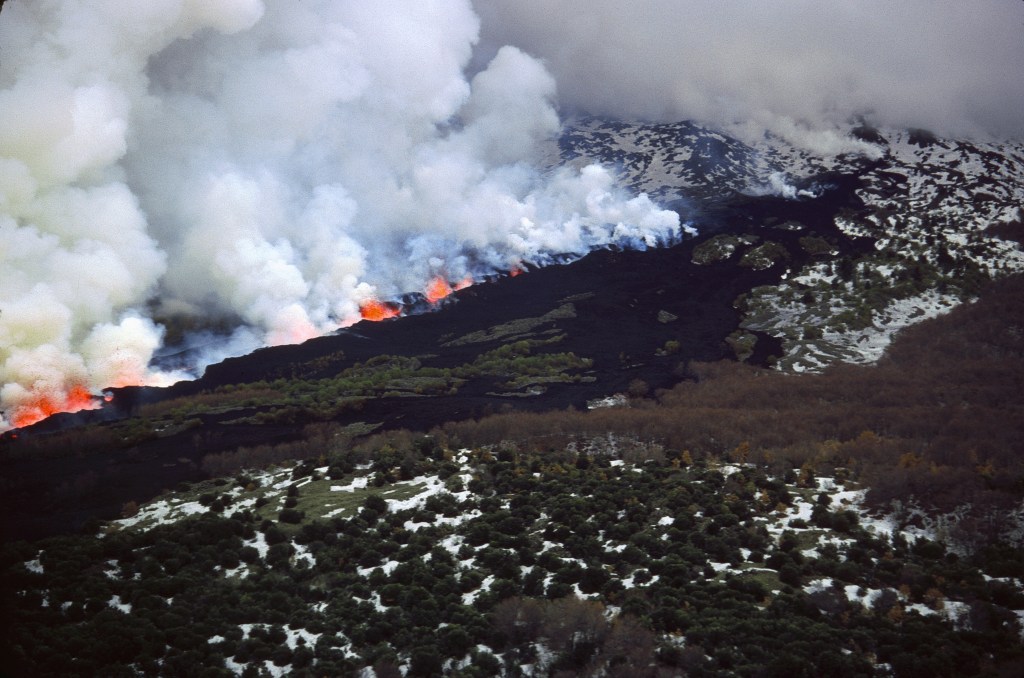
During the early hours of 18 March, the fissure system continued to open at lower elevations and reached about 1,400 metres by late morning. The main lava flow, fed by the vent at 1,800 metres, moved into the area between Randazzo and Montelaguardia. At the same time, other flows from the lower vents descended towards Randazzo.
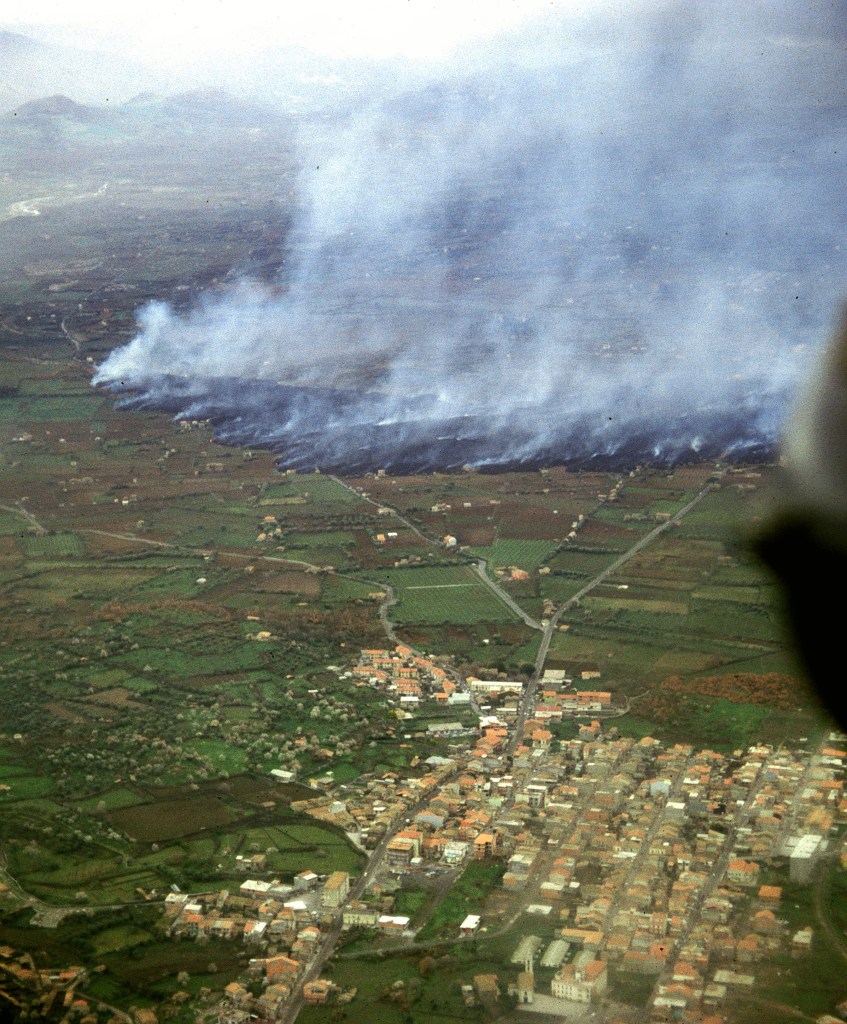
Damage to farmland and infrastructure
Within a few hours, the lava crossed woodland, vineyards and farmland, destroying rural buildings and cutting the main transport routes. It severed the Italian State Railways and Circumetnea Railway lines, State Road 120 and several minor roads.
The flows also destroyed power and telephone lines, temporarily leaving Randazzo isolated. The main front reached the bed of the Alcantara, where it stopped without entering the river, after travelling about 7.5 kilometres from the eruptive vents.
The speed of the advance recalled the 1928 eruption, when an Etna lava flow destroyed much of the town of Mascali. Randazzo and Montelaguardia escaped a similar fate in 1981, but the damage to farmland and infrastructure was still considerable.
19–23 March: the eruption comes to an end
On the afternoon of 18 March, the propagation of the fissures ended with the opening of small vents at elevations between 1,250 and 1,115 metres. These emitted smaller volumes of lava, and the eruption gradually began to lose intensity.
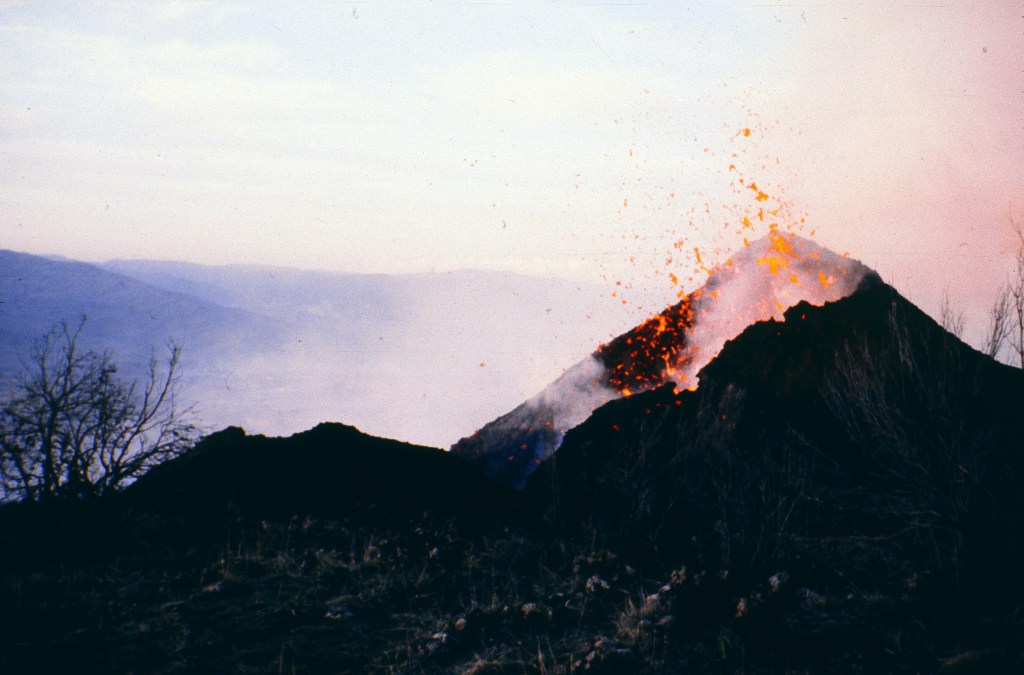
Weak Strombolian activity continued until 23 March, providing only a limited supply to the flow heading towards Randazzo. The lava front finally stopped about two kilometres from the town.
Why the 1981 lava flow moved so quickly
The total volume of the eruption has been estimated at between 20 and 30 million cubic metres, a quantity that is not exceptional for Etna. What made the event unusual was the rate at which lava was emitted during its initial phase.
A scientific reconstruction published in 2012 calculated a maximum discharge rate of about 640 cubic metres per second. This value is unusually high for Etna and consistent with the extremely rapid advance observed on the ground. According to the study, rising magma may have intercepted a shallow magma reservoir, adding its contents to the flow and causing a sudden increase in discharge.
Remembering the eruption
Accounts collected in later years describe three dramatic days: homes and farmland lost, animals that could not be rescued, water tanks engulfed by lava and families forced to move away as the flow advanced.
These accounts also point to difficulties in the circulation of information. The possibility of an imminent eruption had been reported by the international press on the previous day, yet some local residents only became aware of the event when the lava was already visible near the outskirts of Randazzo.
The 1981 eruption therefore remains an important case study. It shows how an event with a relatively limited volume can still have serious consequences when vents open at low elevation and lava is emitted at an exceptionally high rate.
Frequently asked questions about Etna’s 1981 eruption
When did the 1981 eruption begin?
The first eruptive fissures opened on Etna’s northern flank on 17 March 1981. The most intense phase was concentrated between 17 and 19 March, while weak residual activity continued until 23 March.
Did the lava reach Randazzo?
No. The main lava flow crossed farmland and cut roads, railways and utility lines, but stopped before reaching the town centre.
How much lava was emitted?
The total volume is estimated at between 20 and 30 million cubic metres. The reconstructed maximum discharge rate was about 640 cubic metres per second.
Why is this eruption considered exceptional?
Because eruptive vents opened progressively at lower elevations while the initial discharge rate was extremely high. Together, these two factors allowed the lava to advance very rapidly towards farmland, infrastructure and inhabited areas.
Scientific source
Mauro Coltelli, Maria Marsella, Cristina Proietti and Silvia Scifoni, The case of the 1981 eruption of Mount Etna: An example of very fast moving lava flows, Geochemistry, Geophysics, Geosystems, 2012. DOI: 10.1029/2011GC003876.