
When we picture the crater of a volcano, the image is almost always the same: an explosion firing ash and lapilli into the sky, carving a hollow at the top of the mountain. On Etna, however, there are craters formed in exactly the opposite way — not because something was pushed out, but because the support beneath gave way and the ground sank. These are pit craters, or collapse craters: shafts with vertical walls that open in silence and reveal what is happening inside the conduit, tens of metres below.
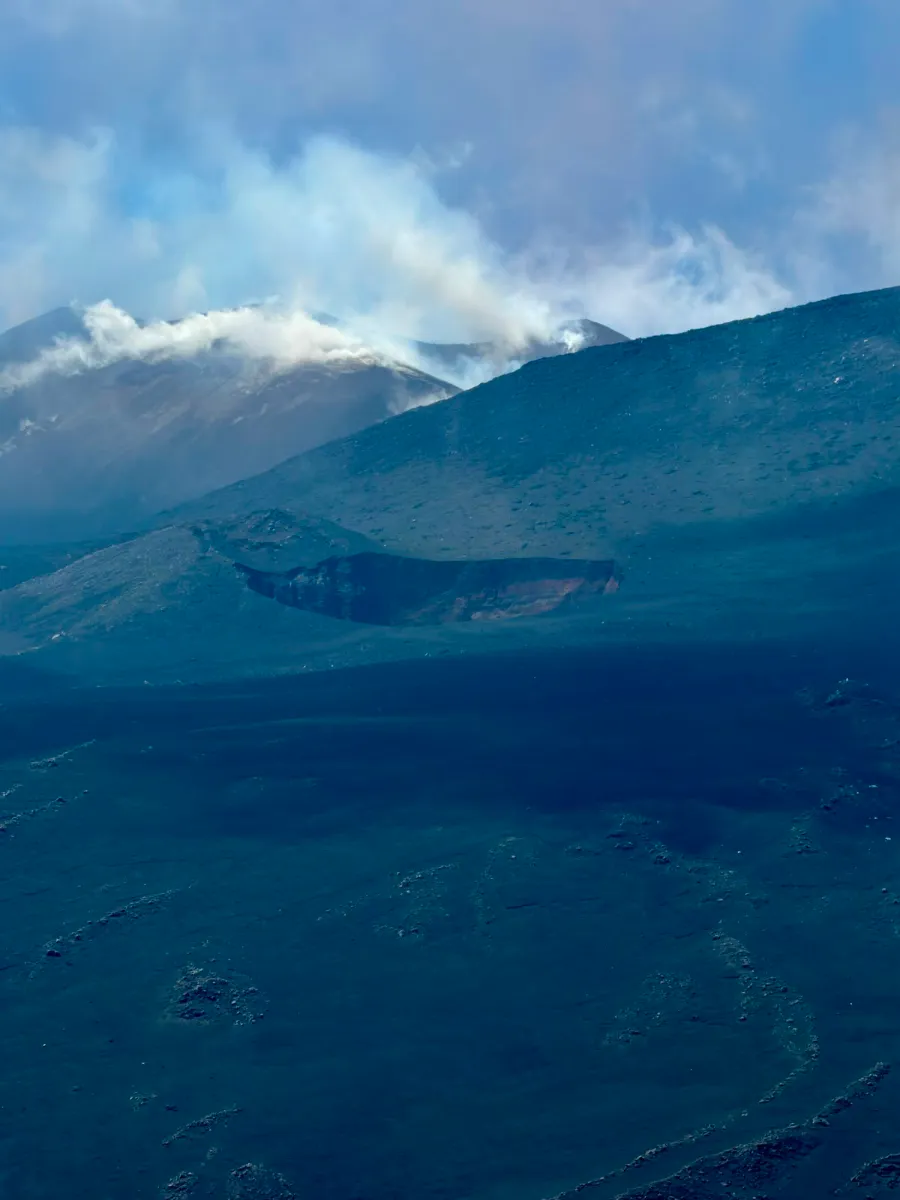
It is neither a rare nor a distant phenomenon. In recent days, during the eruptive phase of August 2026, a pit crater has again become clearly visible at the base of the North-East Crater: a structure our guides watch closely, because it is quite literally a window onto the inside of the volcano.
In this article we look at what a pit crater is, how and why it forms, how it differs from an explosive crater and how to recognise one while walking the high-altitude trails of Etna.
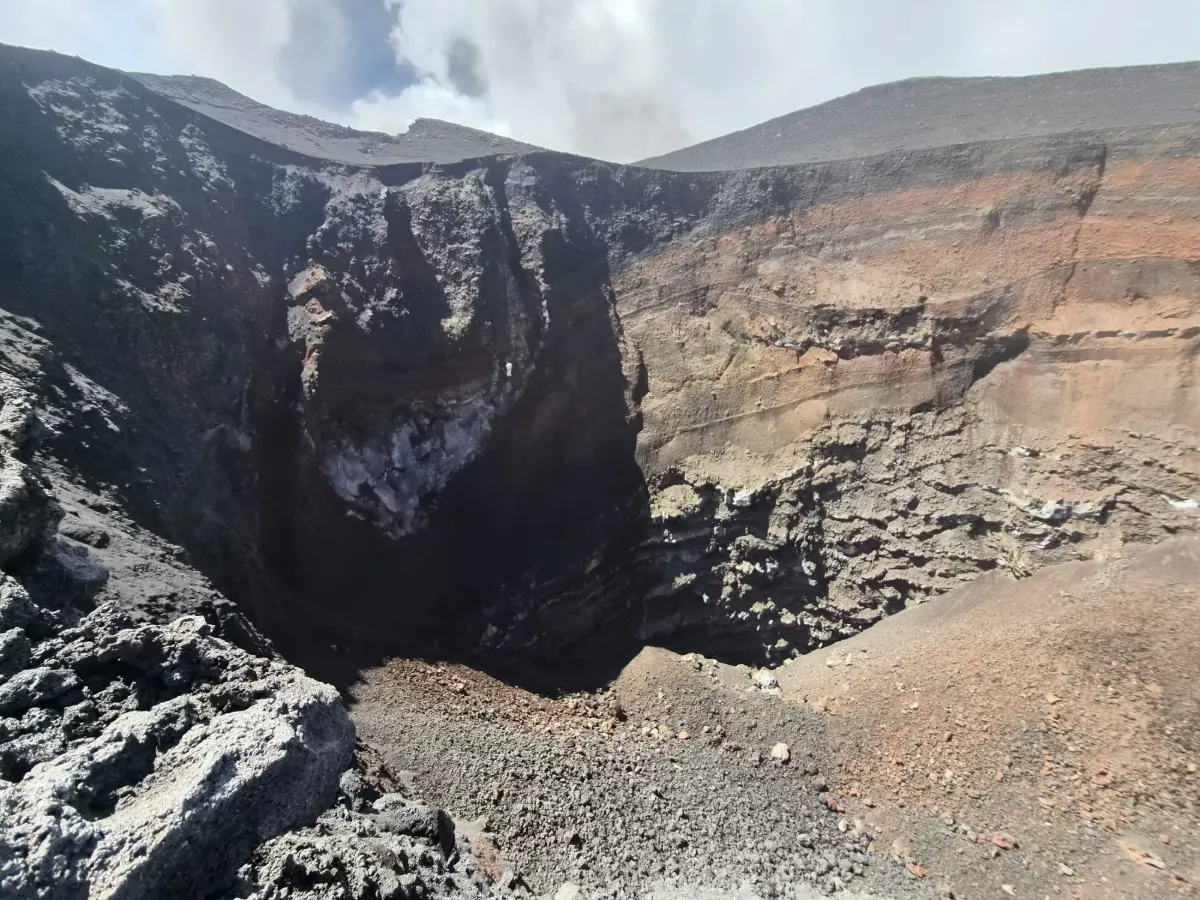
What is a pit crater
A pit crater is a circular or elliptical depression with steep, vertical walls, formed on the surface of a volcano. The English name describes its shape well: a clean shaft, often sheer, that opens in the ground without building anything around itself.
The difference from a classic volcanic crater lies entirely in its origin. An explosive crater is excavated from the inside out, and around the vent it piles up the pyroclastic material thrown into the air by the eruption: that is why it has a raised rim. A pit crater does not. It is born from a structural collapse, a downward failure. Its edges therefore stay flat, level with the surrounding ground.
The distinction may sound technical, but it completely changes the meaning of what you are looking at. An explosive crater tells the story of an eruption that happened; a pit crater tells the story of a void that formed at depth.
How and why a pit crater forms
A collapse crater forms in three stages.
- Emptying of the subsurface. A cavity forms beneath the surface of the volcano. This can happen when a lava tube drains at the end of an effusive eruption, when a magma chamber deflates after erupting, or when magma migrates sideways along fissures and dykes, abandoning the section of conduit it occupied.
- Fracture propagation. With the support of the magma gone, the overlying rock — the “roof” of the cavity — has to bear its own weight alone. Gravitational stress generates vertical fractures that propagate progressively upwards, until they approach the surface.
- Gravitational collapse. At that point the rock mass fails and collapses downwards into the void. What remains at the surface is a deep shaft, with almost perfectly vertical walls and, as noted, no raised rim.
The collapse may happen all at once or, more often, through successive failures: the pit widens over time, eating away at its own walls, and can change in diameter and depth within a few weeks.
How to recognise a pit crater on Etna
If you are walking Etna’s high-altitude trails — or those of any other basaltic volcano, from Hawaii to Réunion — three clues let you identify a pit crater at a glance.
- No raised rim. There are no mounds of ash or lapilli around the opening. The ground reaches the edge and stops abruptly.
- Sheer walls. The walls drop vertically and are “bare”: they expose in cross-section the layers of lava rock built up by previous eruptions, like the pages of a book cut along its side.
- Regular shape. The circumference is often sharply defined, almost geometric: the impression is of a natural well rather than an eruptive vent.
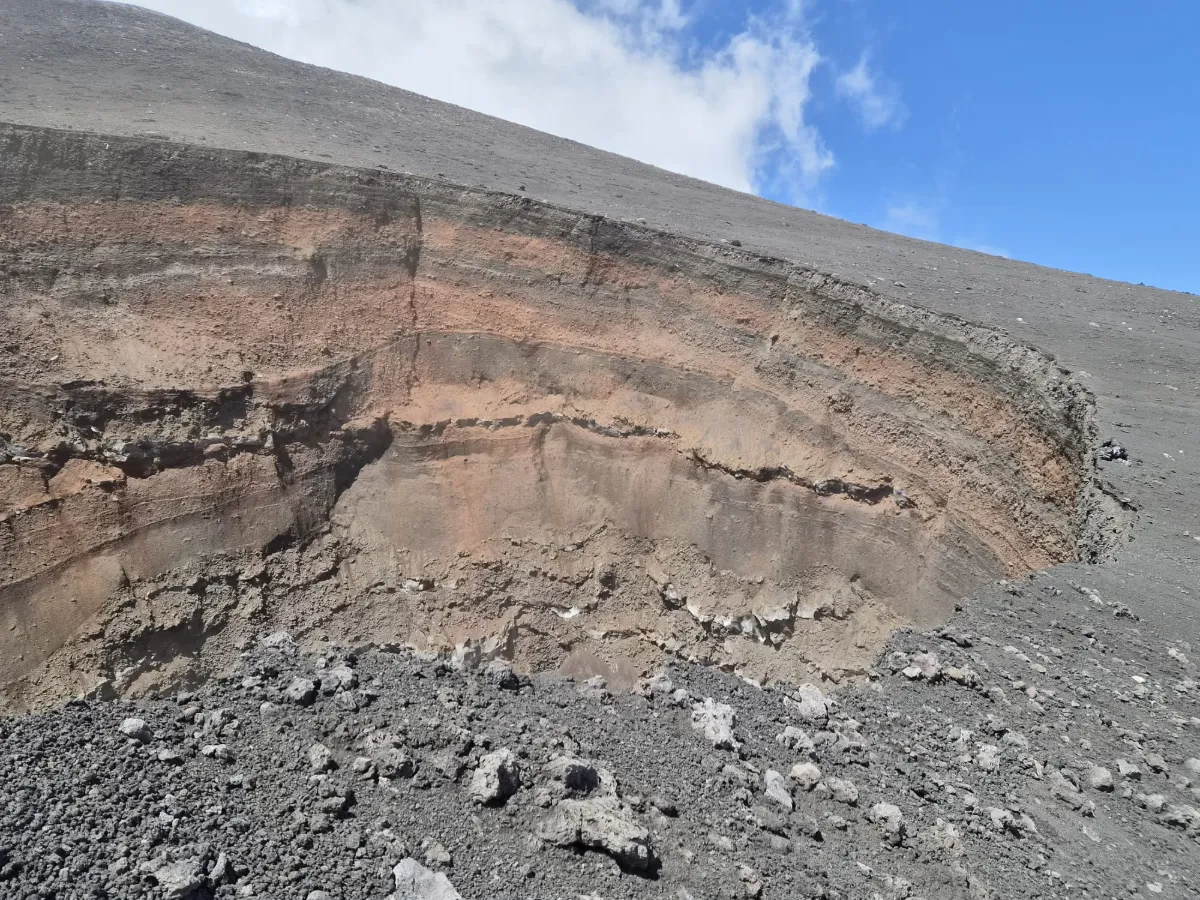
To these a fourth, more dynamic signal can be added: many of Etna’s pit craters degas continuously. A flow of hot, pressurised gas rises from the floor, making the structure visible from a distance on cold days.
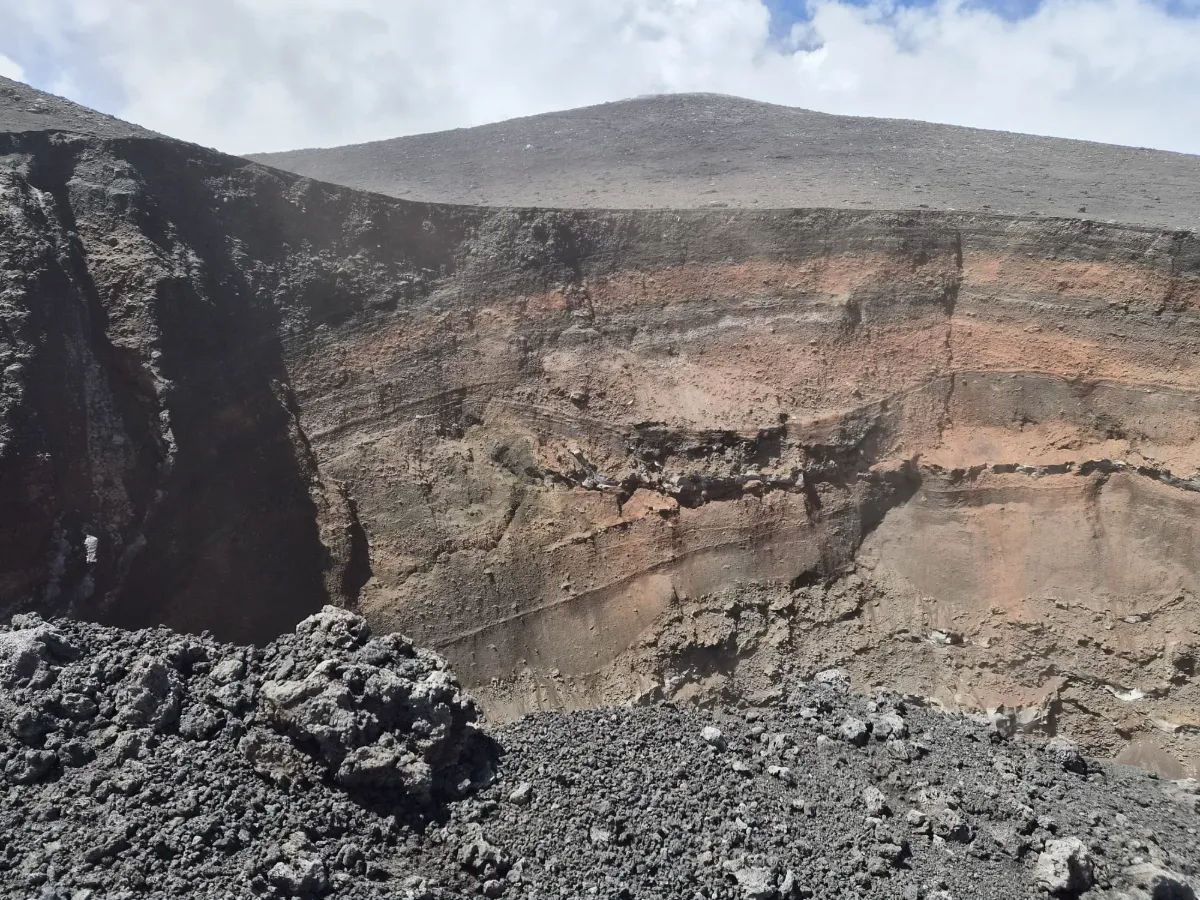
Pit craters in Etna’s recent history
On Etna, collapse craters are no marginal curiosity: some have reshaped the geography of the summit itself.
The Bocca Nuova (1968)
What is today one of the four summit vents, roughly 500 metres wide and at least 200 metres deep, was in 1968 merely an incandescent collapse about ten metres across, opened on the western flank of the Central Crater. From there it widened progressively, reaching a diameter of several hundred metres as early as the 1980s. A pit crater that became a summit crater in its own right.
The New South-East Crater (from 2007)
This is the most spectacular case. In 2007 a collapse depression opened on the lower eastern flank of the South-East Crater. In November 2009 a second depression formed on the rim of the first and, during 2010, successive failures merged them into a single enormous pit crater. From that chasm, starting in 2011, a very long series of paroxysms built a cone more than 200 metres high: the New South-East Crater, today the most dynamic structure and often the highest point of the entire volcano.
It is the clearest demonstration that a pit crater is not an end state but frequently a starting point: the void left by magma becomes the pathway along which later magma will rise again.
The Bocca Nuova pit (2023)
In July 2023 a new pit opened near the southern portion of the Bocca Nuova rim, earning the nickname “the breathing vent” for its pulsing degassing. A small structure compared with the earlier cases, but followed with great attention because it signalled a drop in the magma level within the conduit.
Why pit craters matter so much to volcanologists
A pit crater is an indicator. Its appearance signals that something has emptied at depth: the magma level in the conduit has dropped, or part of the plumbing system has been abandoned. Its widening, its deepening and the intensity of the gas escaping from it are parameters that researchers at INGV monitor alongside volcanic tremor and ground deformation.
For anyone walking on Etna, all this translates into something very concrete: the pit crater visible today at the base of the North-East Crater is not a fixed feature of the landscape. It is a young, unstable, evolving structure that can change shape from one week to the next, and whose edges can retreat without warning. Approaching it therefore has to be handled by people who know the current morphology of the summit — and this is why, above 2,920 metres, the regulations of the Etna Park require accompaniment by authorised volcanological guides.
Seeing them in person: what changes on a hike
Looking closely at a collapse crater changes the way you see the whole mountain. In front of a scoria cone you see the result of an eruption; in front of a pit crater you see the imprint of a void — proof that Etna, as well as building itself up, is continuously demolishing itself from within.
During our excursions to the summit craters and along the high-altitude routes, pit craters are among the most interesting features to read: a few metres of vertical wall sum up decades of eruptive history, and let you understand with your own eyes what the bulletins describe in numbers.
Experience Etna with EtnaHiker
Collapse craters are one of the best keys to understanding how Etna really works, from the inside. Discover EtnaHiker’s excursions and climb to altitude with authorised volcanological guides, who turn every stop into a story of the ground beneath your feet.
To put it all in context, read our piece on the summit craters of Etna and, if you want to trace the volcano back to its origins, the article on Acitrezza and the columnar basalts.
Frequently asked questions about Etna’s pit craters
What is a pit crater?
It is a collapse crater: a circular depression with vertical walls, formed by the gravitational collapse of the ground rather than by an explosion or by the build-up of pyroclastic material around an eruptive vent.
What is the difference between a pit crater and an ordinary volcanic crater?
An explosive crater forms through the ejection of material and has a raised rim of ash and lapilli. A pit crater forms by downward collapse and has flat edges, level with the surrounding ground, with sheer walls.
How does a pit crater form?
In three stages: a cavity forms in the subsurface (through the draining of a lava tube, the deflation of a magma chamber or the lateral migration of magma), the overlying rock fractures under gravitational stress, and finally it collapses into the void.
Are there pit craters on Etna?
Yes, and some have played a decisive role. The Bocca Nuova began in 1968 as a collapse just a few metres across, and the New South-East Crater developed from the large pit crater that formed between 2007 and 2010 on the eastern flank of the South-East Crater.
Why are pit craters found mainly on basaltic volcanoes?
Because basaltic lavas are fluid and readily form lava tubes and open conduits which, once drained, leave cavities in the subsurface. That is why they are common on volcanoes such as Etna, Kilauea in Hawaii and Piton de la Fournaise on Réunion.
Can you see pit craters on an excursion on Etna?
Yes, in the summit area. As these are unstable, continuously evolving structures, however, they should be viewed with authorised volcanological guides: above 2,920 metres, accompaniment is mandatory under the regulations of the Etna Park.