
There’s a moment, climbing along Etna’s high-altitude trails, when the landscape changes its very nature. The vegetation disappears, the ground turns dark and sandy, the air carries the sharp smell of sulphur. Ahead open the summit craters: the active vents that crown the top of the volcano, at over 3,300 metres of altitude. They are the beating heart of Etna, the point where magma meets the sky, and they offer the most spectacular scenery an excursion on Europe’s highest active volcano can give.
In this article we look at which the summit craters are, when they formed, at what altitude they sit and how the eruptive activity works that keeps them in constant transformation.
How many summit craters does Etna have, and which are they
Today the top of Etna is occupied by four main eruptive structures: the North-East Crater, the South-East Crater and the Central Crater, which within it encloses two distinct vents, the Voragine and the Bocca Nuova. This is why people commonly speak of the “four summit craters”: North-East, South-East, Voragine and Bocca Nuova.
These are not ancient, unchanging formations. On the contrary, they were all born within the last century and continue to change shape, altitude and activity year after year, shaped by the eruptions that feed them.
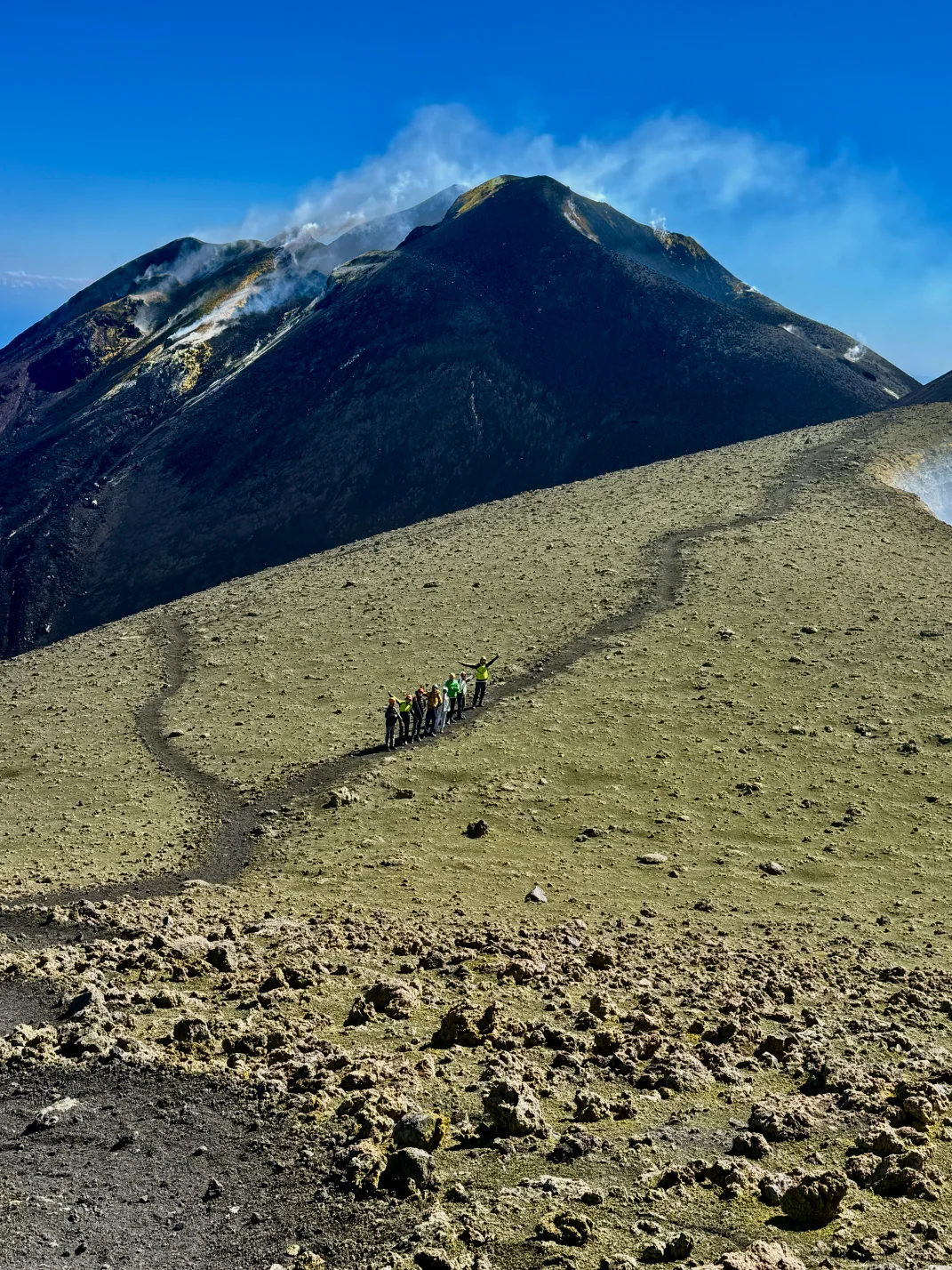
North-East Crater
Born in 1911, the North-East Crater was for many decades the highest peak of the volcano. Its eruptive history, made of powerful lava fountains and lava flows, has shaped its cone over time, and it still dominates the northern sector of the summit today.
Cratere di Sud-Est
It is the youngest of the four: it formed in 1971 as a small vent on the flank of the Central Crater. Since then it has grown remarkably and, following intense explosive and eruptive phases — the famous “lava fountains” or paroxysms — it has repeatedly returned to contend for the title of highest point of Etna. It is the most dynamic crater and the protagonist of much of the activity in recent years.
The Voragine
Formed in 1945 within the Central Crater, the Voragine is today the structure that, together with the South-East Crater, contends for the maximum altitude of the volcano: around 3,400 metres. The exact height of Etna’s summit, in fact, is not a fixed value: it is periodically re-measured because eruptions and collapses modify it from season to season.
The Bocca Nuova
Born in 1968, the Bocca Nuova also lies within the Central Crater, next to the Voragine. It stands out for its deep depressions and for intense degassing, which makes it one of the most striking — and changeable — points of the entire summit.
At what altitude they sit: Etna’s “moving” summit
Etna is the highest active volcano in continental Europe. Its summit altitude today hovers around 3,300–3,400 metres, but it is a value in constant evolution: the accumulation of eruptive products makes the cones grow, while explosions and collapses lower them. In recent years the record for highest point has passed several times from the North-East Crater to the Central Crater area, up to the current leading role of the South-East Crater.
It is a detail that tells the nature of Etna well: not a “finished” mountain, but a volcano that builds and demolishes itself, before the eyes of those who walk it.
How Etna (and its craters) formed
Etna has a very long eruptive history, going on for over half a million years. Only in the last hundred thousand years, however, has it taken on the characteristic conical shape that distinguishes it today.
The mechanism that feeds the summit craters is, in the end, simple: magma rises towards the surface through an open central conduit, which continuously releases its gaseous phases. It is precisely this degassing that generates the characteristic plume almost always visible above the summit of the volcano — Etna’s “breath”, visible from kilometres away.
Etna’s eruptive activity: three ways of erupting
Observing Etna over time, volcanologists classify its activity into three main categories. Understanding them helps to read what you see — and hear — walking at altitude.
- Persistent activity. This is the continuous degassing from the summit craters, which can evolve into low-energy Strombolian activity: small rhythmic explosions that throw out shreds of incandescent lava. It is the volcano’s “normal state”, the one that keeps Etna active practically all the time.
- Terminal and subterminal eruptions. These are the lava eruptions and lava fountains that occur directly from the summit craters (terminal) or in their immediate vicinity (subterminal). They are the most scenic events of the summit.
- Lateral and eccentric eruptions. These occur from vents that open along the flanks of the volcano, fed by magma rising along the central conduit (lateral) or through conduits independent of the central one (eccentric).
If you want to explore the explosive phenomena that accompany these phases, you’ll find a dedicated overview in the articles on the EtnaHiker blog about pyroclastic flows and Strombolian activity at the summit craters.
Rifts, adventive cones and “button-holes”: the volcano beyond the summit
Etna’s activity does not end at the summit. Lateral and eccentric eruptions have given rise, over time, to several hundred adventive pyroclastic cones, concentrated above all along three great lines of weakness known as volcanic rifts: the South Rift, the West Rift and the North-East Rift.
When several cones grow one beside the other along the same eruptive fissure, they form the so-called “button-holes” (bottoniere). Their dimensions are extremely variable and can reach considerable volumes — up to almost 100 million cubic metres. From the eruptive vents come lava flows with temperatures around 1,050–1,150 °C, generally very fluid, capable of travelling several kilometres depending on the effusion rate, the slope gradient and the physical-chemical characteristics of the magma.
It is precisely the lateral and eccentric eruptions that are the most fearsome for the towns of Etna: they tend to open at lower altitudes, where nearly one million people live spread across the flanks of the volcano. To this is added a lesser-known but constant phenomenon: the eastern flank of Etna is slowly deformed and translated towards the East and South-East, with average rates that sometimes exceed 2–4 cm per year, along active faults that cross densely inhabited areas.
Reaching the summit craters: altitude, access and authorised guides
Reaching the summit craters is an experience that leaves its mark — but it is also a high-altitude environment that must be approached in the right way. A few fixed points:
- The altitude. You go well above 3,000 m: cold, wind and strong solar radiation are the norm even in high summer. You need layered clothing, trekking boots and sun protection.
- The mandatory guide. Under the rules of the Etna Park, access to the summit zone above 2,920 metres is permitted only with authorised and experienced volcanological guides. This is not a formality: the morphology of the summit changes with the activity of the volcano, and only those who know it and monitor its evolution can accompany hikers all the way up.
- Access from South and North. You can climb both from the southern flank (Rifugio Sapienza) and from the northern one (Piano Provenzana): two routes, two landscapes, but the same goal. We cover this in detail in our guide on how to reach the summit craters.
Experience the summit craters with EtnaHiker
The summit craters are the most intense experience Etna can offer: walking on the rim of an active volcano, amid the hiss of gases and the smoking earth, is something you remember for a long time. Discover EtnaHiker’s summit craters excursion and climb to altitude accompanied by authorised volcanological guides, who turn every stage into a story of the volcano.
Frequently asked questions about Etna’s summit craters
How many summit craters does Etna have?
There are four: the North-East Crater, the South-East Crater and the Central Crater, which within it encloses the Voragine and the Bocca Nuova.
What is the highest point of Etna?
Etna’s summit is around 3,300–3,400 metres, but the altitude is not fixed: it changes with the eruptions. In recent years the record has passed several times between the North-East Crater, the Central Crater area (Voragine) and the South-East Crater.
When did the summit craters form?
They are recent structures: the North-East Crater was born in 1911, the Voragine in 1945, the Bocca Nuova in 1968 and the South-East Crater in 1971. They are still changing today.
Can you visit Etna’s summit craters?
Yes, on a guided excursion. Above 2,920 metres, the rules of the Etna Park require the mandatory accompaniment of authorised and experienced volcanological guides.
Why does Etna always have a plume of smoke at its summit?
Because the magma rises along an open central conduit and continuously releases gas: it is the persistent degassing that generates the characteristic plume visible from the summit.
Which is the most active crater on Etna?
In recent years the South-East Crater is the most dynamic: it has been the protagonist of numerous lava fountains (the so-called paroxysms) and has repeatedly returned to being the highest point of the volcano.